


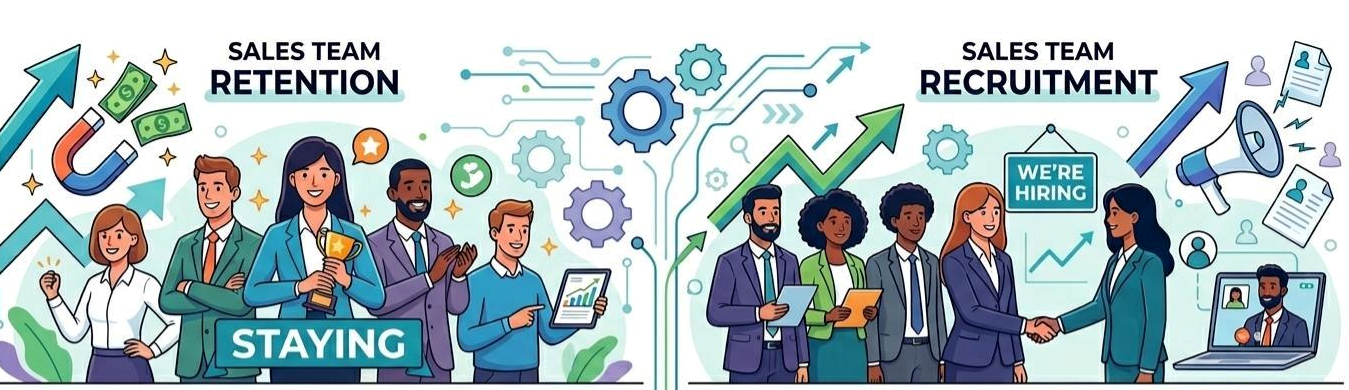
Some days ago, I came across a Harvard Business Review article by Nick Toman and John Staples, which highlights one of the most critical challenges that commercial leaders are faced with intertemporally: retaining top Sales talent amid widespread labour market volatility. Even though this article was published nearly four years ago, in my view it does accurately describe the situation nowadays.
In the survey that preceded their article, the authors approached 650 Sales professionals, and their main finding was that more than half of them (56%) were seeking new working environment. Contrary to common assumptions, job-hopping is not primarily driven by younger generations, but it is more prevalent among experienced Generation-X professionals. Their research also reveals that job satisfaction is not a reliable predictor of retention, as a substantial portion of satisfied and high-performing salespeople continue exploring new opportunities.
Moreover, traditional retention levers such as pay increases, promotions, titles, or improved work-life balance seem to have limited impact. Instead, Sales professionals greatly appreciate a clear and achievable path to success and value organisations that actively support their short- and long-term development. Ultimately, retention is driven by helping Salespeople believe they can succeed and grow, making investments in capability building that will lead to performance enhancement far more effective than short-term financial fixes.
Currently, nearly every Sales leader, with the aid of HR, devises a hiring plan that is usually documented, budgeted and frequently reviewed, but very few seem to have a real retention strategy that is tracked and treated with the same rigour. For years, recruitment has focused on finding talent fast, but as we speak, retention is becoming the new recruitment for Sales organisations, because keeping great people has become more valuable strategically and more cost-effective than constantly trying to replace them.
Specifically, according to relevant studies, when a Salesperson decides to leave his/her current employer the cost for the company can be from 50% to 200% of this person’s annual salary, when we also consider hiring, training, possible loss of opportunities and the disruption in customer relationships. Regarding the latter, in B2B environment it can be a differentiating factor, so when a Sales professional leaves, customers may feel “orphaned”, trust that was built throughout the years could be lost and active opportunities/deals may stall, giving the competition the chance to exploit the transition period.
From the above it is clear that retention can save money, protect revenue and ensure continuity, loyalty and higher customer lifecycle value. On top of that, many organisations report that it takes between nine to twelve months for a new Sales representative to reach full productivity, so it is evident that productivity compounds with tenure. Finally, although it seems contradictory, retention can become a recruitment driver for companies. In Sales, reputation spreads fast, so if an organisation is known for the short and long-term development of its’ Salesforce, then it is highly probable that it will attract better candidates.
It is high time that companies devised a clear retention strategy, since investing in this field through training, recognition and career growth of their Salespeople can cost far less than replacing them. In a market that great Sales talent is not easy to find, organisations should not only focus on improving their hiring processes, but they need to prioritise building roles that would make people want to stay in, therefore protecting culture, stability and productivity, which can make the difference among their competition.