


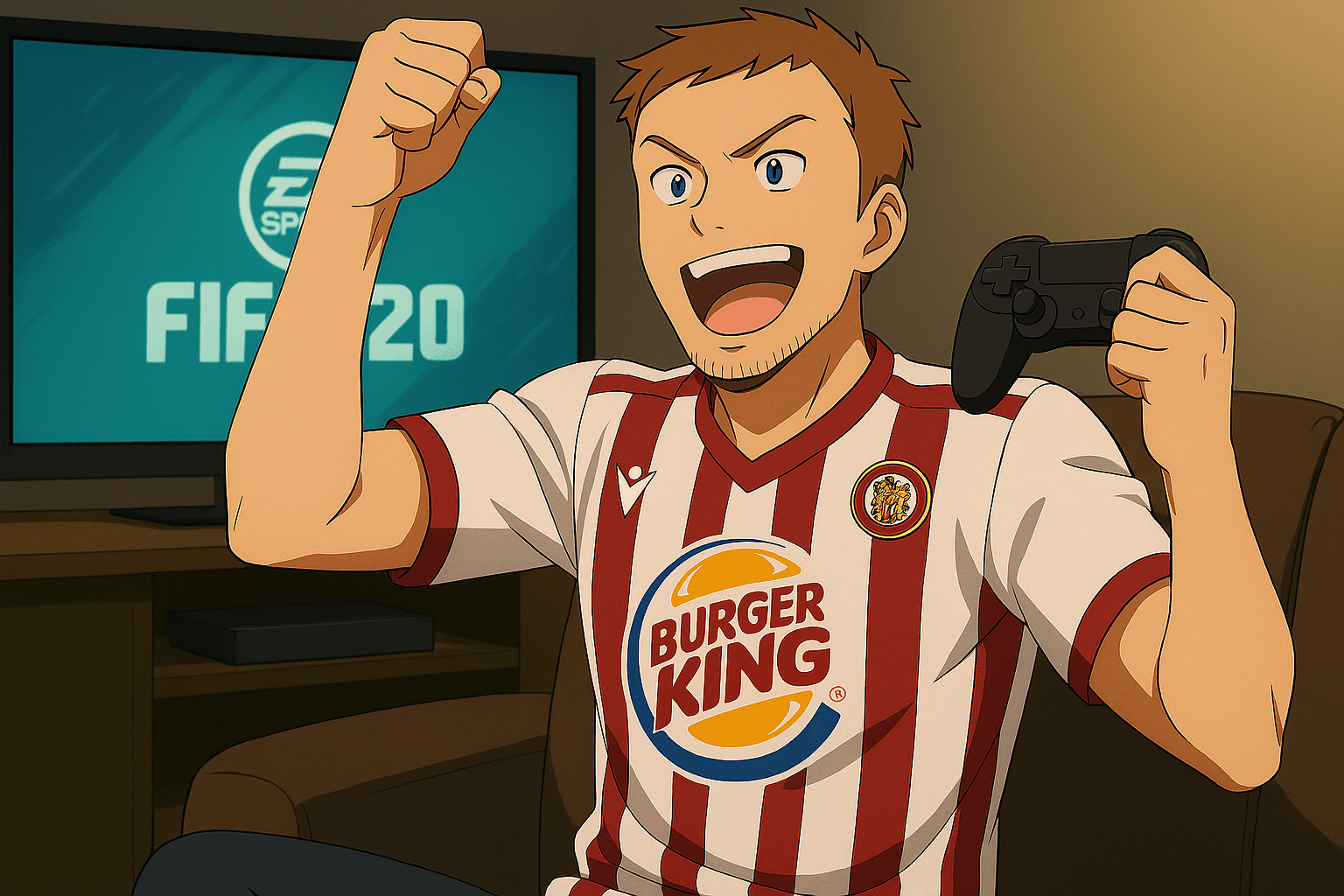
In a global sports landscape that is dominated by powerful clubs, celebrity-status players and sponsorship deals worth millions of euros, we can easily assume that to be successful in sports marketing requires immense scale, making it extremely difficult, especially for smaller brands, to even consider investing in this field. Nevertheless, in one of the most innovative campaigns ever to take place, Burger King instead of spending millions teaming up with a globally known club, chose to sponsor Stevenage FC, a team playing in League Two, which is the fourth tier of the English football league system, for about 60.000 euros. So, what was the logic behind this move and what was the impact that it had on the brand?
The sponsorship deal meant that Burger King’s logo would appear at the front shirt of the team, but instead of just involving the physical kits, it also appeared in their in-game kits in FIFA 20, a hugely popular video game played by millions of people around the globe. This meant that their logo would be visible not only to the seven thousand fans at Lamex Stadium, home ground of Stevenage FC, but also to the numerous players worldwide.
With that as a base, Burger King launched the #StevenageChallenge, calling to action gamers by inviting them to pick Stevenage FC in FIFA 20, score goals while wearing their sponsored kit and share the goal clips on social media, to win free meals and other rewards from the fast-food chain. Consequently, over twenty-five thousand goals were shared online, as gamers took on the challenge and Stevenage FC became one of the most played teams in the game. The campaign generated more than 1.2 billion media impressions bringing visibility not only to Burger King but also to the club, as its’ replica shirts sold out for the first time, while the fast-food chain earned more than two million euros in media exposure. Apart from the numbers, the concept received such an acclaim that it was awarded the Cannes Lion Grand Prix, one of the greatest honours in the marketing and advertising industry.
The above case study is a powerful reminder that creativity may lead into places that budget alone cannot. Burger King “hacked” the system by finding a cheap entry point through a small real-world sponsorship that unlocked a huge global audience in an existing digital ecosystem and by incentivising participation, turned this audience into content creators. A clever idea combined with a clear understanding of how fans behave in the digital environment, became the foundation for something a lot bigger than a traditional marketing campaign.
I firmly believe that even small businesses can replicate this strategy, by initially looking for existing communities or platforms aligned with their brand, where they can appear with low investment but visibly, such as niche sports clubs, events, local creators etc, primarily aiming to buy placement rather than attention. The second step would be to create a fun and easy-to-achieve challenge where individuals can participate without too much effort, incentivising them meaningfully through discounts, free products, loyalty points or limited-edition merchandise. People love challenges that are aimed at themselves, so the target would be to activate them to become co-promoters. They also love to turn an underdog into a hero, so small brands could embrace the underdog position, making their customers feel that they are part of a small but growing movement, appealing to their emotions, just as the tiny Stevenage FC became one of the most played teams in FIFA 20.
In my view, the most important conclusion is that rather than trying to outspend our rivals, we need to find ways to outthink them. This is exactly what Burger King did in this case, as although they are a worldwide brand with huge number of resources, they still thought out of the box and launched a low-cost, low-risk unconventional campaign, which became one of the best examples of modern, cost-effective and digitally amplified marketing.