


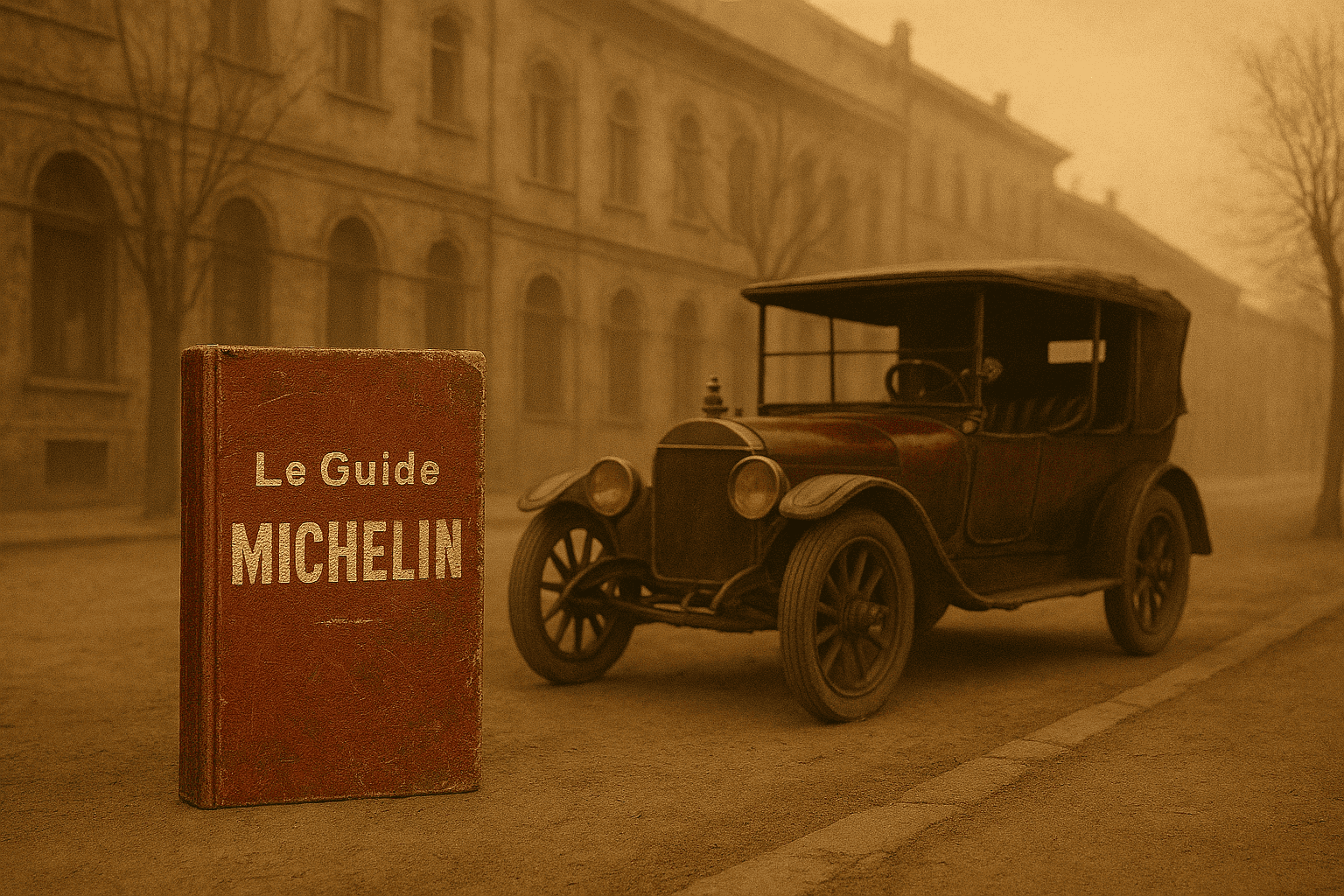
“How do we get people to drive more, so they use more tires?” This was the key question that was posed from brothers Édouard and André Michelin at the early 1900s, an era when there were only three thousand cars circulating the roads of France, with people not driving often, which meant that they didn’t wear out their tires, so fewer worn tires lead to fewer sales for their business. The genius solution that they came up with was the launch of Michelin Guide, a free (initially) booklet for drivers that contained maps, a list of hotels and restaurants and tips for maintaining cars. But how on earth could this red booklet be the answer to their problems?
The Michelin brothers took over their grandfather’s factory in 1889, when the company was mainly manufacturing rubber farm equipment. One day, a cyclist entered their factory with a tire that needed repair, so the brothers spotted an opportunity, as at that time, bicycle tires were glued to the rims, making repairs very time-consuming. The innovation that Michelin came up with was the detachable pneumatic tire, which was quick to remove and repair and therefore more efficient and comfortable for the riders. The main breakthrough for the company came when during the Paris-Brest-Paris race, the cyclist Charles Teront used their new product to win, as he stopped far fewer times than his competitors.
When cars emerged, the company recognised a huge opportunity, with their attention focused on innovations that would make their tires durable and easy to repair. Nevertheless, as we have already seen, the issue was that during this period, there were not many cars in France and that those that existed were not circulating as much as Michelin would like to, so their tires were not wearing out. Therefore, the company issued the Michelin Guide, a booklet that with the information that it contained encouraged people to use their cars and travel. More travel meant more driving, hence more tire usage and eventually more sales for their business.
By the 1920s the Guide started including anonymous reviews of restaurants and to maintain credibility, Michelin hired independent inspectors, started charging for the Guide and removed all advertising. This was followed by their famous star system, where one star meant “very good restaurant”, two stars “restaurant that worths a detour” and three stars "restaurant that worths a special journey”. It is rather obvious that the language that was used (detour, journey), clearly aimed at getting people to travel. Today, Michelin stars are considered to be the highest distinction in the culinary world, a global brand symbol of excellence, which although is entirely independent from the tire business in perception, is undoubtedly reinforcing Michelin’s premium brand identity.
In my view, the Michelin Guide case study is the epitome of strategic marketing, aiming first at creating value and then selling. The company didn’t just push for tires directly, but through the creation of high-value content that created demand, managed to build trust and usefulness solving real customer problems, before expecting customers to buy. Moreover, by becoming the ultimate curator of exceptional restaurants, Michelin directly linked its’ brand with expertise, quality and precision, which transferred back to the perception that customers had for their products (tires), while the consistency in the process of awarding the stars (inspectors anonymity, consistent criteria, rarity) gave the brand prestige and premium positioning.
Finally, this approach is the perfect example that content creation doesn’t have to be about the product itself, but it must put customer first and address his/her lifestyle and needs, while at the same time achieving an emotional connection. Michelin managed to do that as it created a sense of adventure and discovery around travel and dining. Brands manage to grow not by just advertising, but by creating culture and that is exactly what Michelin made possible through this long-term strategy.